OPEN 7 DAYS A WEEK FROM 6:00AM TO 11:00PM

Loading...
Loading...

When should a dog be humanely euthanised?


I have had this conversation in hundreds of Australian lounge rooms as a mobile vet, and it almost always starts the same way. Someone opens the door, apologises for the mess, and then says a version of the same sentence: "I don't know if I'm doing this too early."

Almost nobody asks me if they have left it too late. That tells you something about how this decision usually goes.

This guide is about the timing question specifically. Not what happens on the day, not what it costs, not how the procedure works. Just how to tell where your dog actually is, and how to make the call while you still have room to make it well.

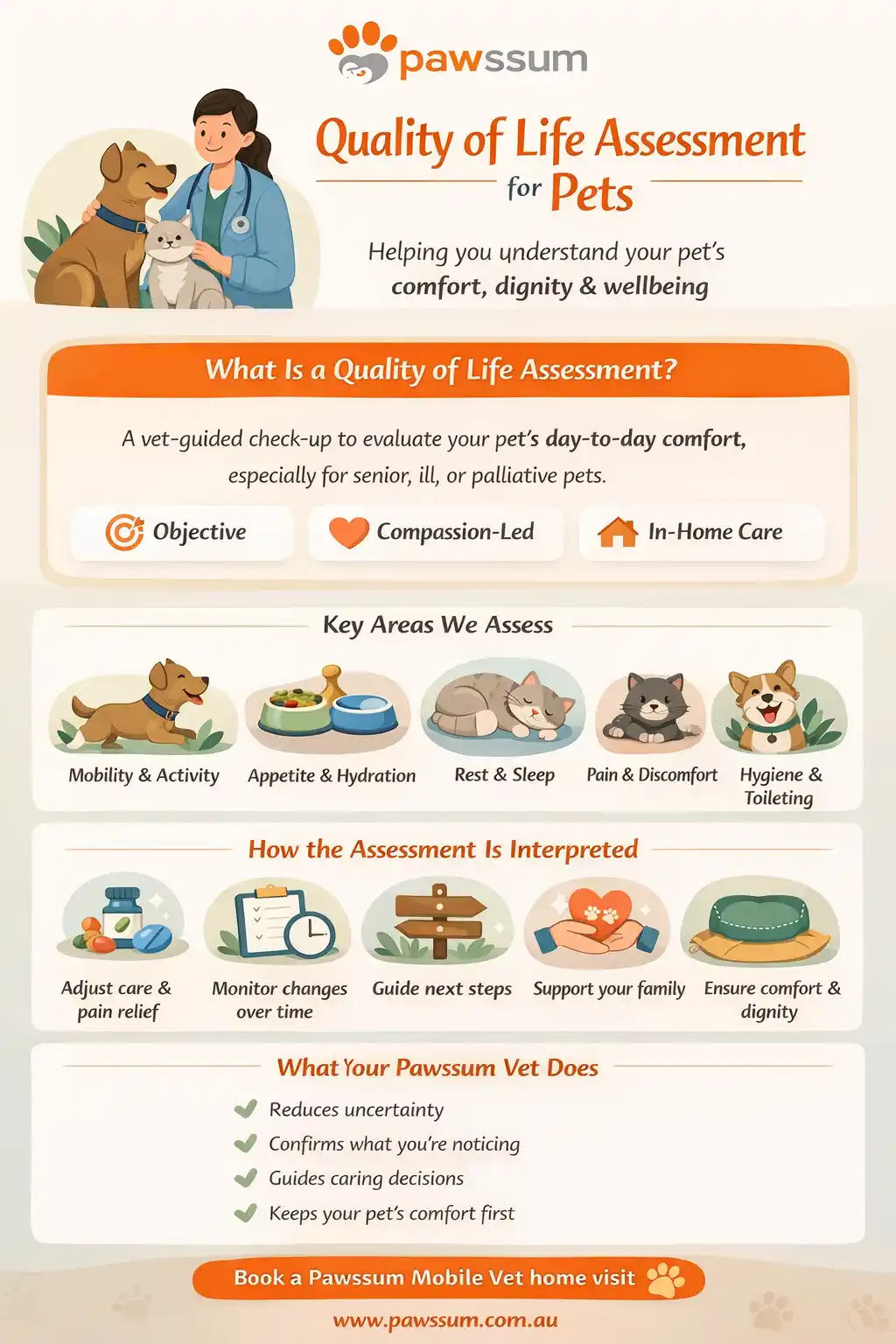
Quality of life

The question I ask first, and why

Before I touch the dog, I ask the owner to describe a normal Tuesday. Not a bad day, not the day something frightening happened. An ordinary one.

What time does he get up. Does he get up on his own. Who helps him. Does he go outside. Does he come to the door when you get home. Where does he sleep now, and is that where he used to sleep.

People start these answers calmly and then hear themselves. They will say something like "well, I moved his bed downstairs in March because the stairs got hard, and then in June I started carrying him out to the grass, and now I bring the grass to him." Said one detail at a time over four months, none of that felt like a decline. Said out loud in ninety seconds, it sounds like exactly what it is.

That gradual adjustment is the single biggest reason good owners leave this late. You do not notice the slope when you are the one walking down it.

A home visit in Melbourne I still think about

A Saturday afternoon in Bentleigh, on my Melbourne run, a few winters ago. A thirteen year old Labrador, hips gone, back end unreliable, on the maximum sensible pain relief his body could handle. Two adults, one teenager, one very quiet kitchen.

They had booked me for an assessment, not a euthanasia. They were genuinely split. Dad thought it was time. Mum thought he still had good days. The son had not said anything at all.

The dog was lying on a folded doona by the back door. He lifted his head for me, which owners always read as a good sign, and it is a good sign, as far as it goes. His pain score was manageable at rest. He was eating. If you had scored him on a chart that afternoon he would have landed in the grey zone, which is where most dogs land, which is why charts alone rarely settle anything.

So I asked the Tuesday question.

Mum answered it. She said that she had been sleeping on the kitchen floor next to him since about April, because he panicked when he woke up alone and could not get himself upright. She said it like it was an ordinary domestic arrangement. Four months of a woman in her sixties sleeping on lino.

Then the teenager spoke for the first time. He said, "He doesn't come to the door any more when I get home."

That was the moment. Not the hips, not the bloods, not the chart. This was a dog whose entire personality had been meeting people at the door, and that had quietly ended weeks earlier, and nobody had said it out loud until then.

We did not rush. I talked them through what I was seeing in his back end, what was realistically left in the toolbox, and what the next few weeks looked like if we kept going. They chose to go ahead that afternoon, at home, in the backyard, on the grass he liked, under a lemon tree. The son sat with his head on his knee the whole time.

What I remember is what Mum said afterwards. Not "I wish we'd had longer." She said, "I think I've been keeping him for me."

That is not a failure. That is love doing what love does. But it is worth knowing that it happens, because it is the thing most likely to blur your judgement.

How to actually track it, instead of guessing

Memory is a terrible instrument here. A dog has one bright hour on a Sunday and it overwrites a fortnight of flat days. Owners then make an enormous decision based on that one hour.

Two methods I give people, both cheap and both more honest than recall.

The calendar method

Put a wall calendar somewhere you pass daily. Every evening, mark the day green for a good day, amber for an average one, red for a bad one. Do not think about it, do not justify it, do not look back at yesterday before you mark today. Thirty seconds.

After two or three weeks you will have something you cannot argue with. Most people are shocked. They are usually looking at more red than they believed, and the reds are clustering rather than scattering. When bad days outnumber good ones, and the run of green is getting shorter, the trend is answering your question for you.

The five things list

Write down five things your dog genuinely loved a year ago. Be specific. Not "walks", but "losing his mind at the sound of the lead". Not "food", but "standing in the kitchen supervising dinner".

Now honestly tick how many they still do, and how many they do with real enthusiasm rather than habit.

Five out of five, you have time. Two or three, you are in the window where a proper assessment is worth booking. Zero or one, the window is closing and I would want to see them soon.

This list is also the thing to write while your dog is still well. Owners who make it in advance find the decision far less murky later, because they are comparing against something they wrote before they were frightened.

What a vet is measuring that you cannot see at home

You know your dog's behaviour better than I ever will. What I add is the physical layer underneath it, and the pattern recognition of having watched a lot of dogs travel this same road.

On a home assessment I am checking hydration, gum colour and capillary refill, heart and lungs, abdominal comfort, muscle loss across the spine and back legs, joint range and pain response, whether the back end knows where it is in space, body condition trend, and what the pain relief is actually achieving compared with what it should be achieving.

I am also watching things a clinic visit hides completely. Whether he can rise from your floor surface, not a rubber-matted consult room. Whether he tracks you around the room. Whether he settles or paces. Whether the house has quietly been rearranged around a dog who can no longer manage it.

Vets often use structured scales, including the HHHHHMM framework, which scores hurt, hunger, hydration, hygiene, happiness, mobility and the ratio of more good days than bad. Pawssum has a free quality of life assessment you can work through at home. Use it as a way to organise your thinking and to see change over time. Score it fortnightly rather than once, because the direction of travel matters more than any single number.

The four things that most often decide it

Across the visits I have done, the same handful of factors do most of the work.

Pain that is no longer answering to treatment

The question is not whether your dog has pain. Plenty of dogs live well with managed pain for years. The question is whether we still have a lever to pull. If we have layered medications appropriately, given them a fair trial, added joint and arthritis support, adjusted the home, and he is still sore, then we have run out of road rather than run out of ideas.

Dogs hide pain from us, so watch for panting at rest, restlessness at 2am, a hunched or tucked posture, reluctance to be touched in a spot he used to love, trembling, or a change in how he holds his head and ears.

Mobility that has become a dignity problem

Slower is not the trigger. Weight-bearing loss is. A dog who cannot get up without help, who slides on floors and stays down, who has to be carried out to toilet, or who soils himself because he could not get outside in time, is losing something dogs care about deeply.

Some of this is fixable. Rugs, ramps, raised bowls, harnesses, nail trims, traction socks and a better sleeping setup buy real time, and I would rather try all of it before we talk about anything else. There is more on that in our guide to keeping senior dogs functional at home. When the modifications stop working, that is information.

Appetite loss, read properly

Appetite is the metric owners trust most and it is the one I trust least on its own. A dog who still eats can still be suffering badly. Labradors in particular will eat through almost anything.

What matters more is the change. Refusing food he has never refused, needing it hand fed, eating only when heavily tempted, or nausea signs like lip licking, drooling and turning away from the bowl. If your dog has gone off his food and there is no obvious reason, that deserves investigation on its own merits, well before any end-of-life conversation.

The personality going quiet

This is the one families notice last and grieve hardest. The dog is still here but the dog is not really here. He does not greet, does not follow you room to room, does not react to his name in the way that used to be automatic, has stopped asking for things.

Sometimes that is canine cognitive dysfunction, which has treatments worth trying and can improve. Sometimes it is chronic pain flattening everything. Sometimes it is an underlying illness we have not identified yet. It always deserves a look rather than being filed under old age.

Signs that mean we should talk today, not next month

  • Laboured breathing, extended neck, elbows held out, or gums that are pale, grey or blue
  • Repeated collapse, or an inability to rise at all without full assistance
  • Uncontrolled vomiting or diarrhoea in a dog who is already frail
  • Open wounds, pressure sores or tumours that are breaking down and will not heal
  • Seizures that are increasing in length or frequency
  • Pain that breaks through medication and disturbs sleep night after night
  • Distress in the early hours, panic, pacing or crying that cannot be settled
  • Aggression that has appeared or worsened, which in an older dog is usually pain or confusion rather than temperament

If any of those are happening now and your dog is in obvious distress, do not sit with it overnight. Speak to a vet the same day, or go to an emergency service if you cannot get help quickly.

Too early, too late, and the space in between

Here is the part owners find hardest, so I will say it plainly.

There is rarely one correct day. There is usually a window of a few weeks where the decision is reasonable, defensible and kind, and either end of that window is a fair place to stand. Before the window, you are taking days your dog would have enjoyed. After it, you are asking your dog to hold on through days that are costing them something.

The reason experienced vets tend to lean earlier within that window is not impatience. It is that dogs rarely get a gentle natural death at home, and waiting for one usually means waiting for a crisis. A crisis happens at 11pm on a public holiday, in a car, in a panic, with the wrong people present and nobody having said what they wanted to say. That is the version families carry badly afterwards.

Choosing inside the window means choosing the room, the people, the blanket, the tree in the backyard. That difference matters more than most people expect it to, and it is the main reason families ask us to come to them.

What I say when families disagree

Split households are the norm, not the exception. Usually one person is closest to the daily care and is exhausted, and another person sees the dog in bursts and sees the good moments.

Two things help. First, get everyone marking the same calendar for two weeks, so you are arguing about a shared record rather than duelling impressions. Second, book an assessment visit with no commitment attached. A vet in your lounge room, describing what they are physically finding, gives a family a common set of facts, and it takes the weight of the decision off whichever person has been carrying it alone.

If you are dreading raising it at all, we have written separately about how to start that conversation with your vet. You will not shock us and you will not be judged. Our Q and A with Dr Jessica Goh answers a lot of what owners are too embarrassed to ask out loud, and if you would rather talk it through before anyone comes to the house, a video consult is often the easiest first step.

Guilt, and the thing nobody tells you

Guilt turns up regardless of timing. Owners who choose early feel they stole time. Owners who choose late feel they let their dog suffer. The guilt is not evidence that you got it wrong. It is evidence that you loved the animal.

The one thing I would ask you to protect yourself from is the version of guilt that comes from an emergency you could see approaching. If you are already asking the question, you are not asking it too soon. Owners who ask it too soon do not exist in my experience. Owners who ask it too late are in my diary most weeks. If you want to know what other families made of how we handled it, our reviews are worth a read, and preparing for end of life covers the emotional side in more depth than I can here.

Where to go from here

If your dog is somewhere in the grey zone, a home assessment is a genuinely useful next step, and it does not commit you to anything. Our Melbourne mobile vets and teams across our other locations do these visits daily. We will examine your dog on their own floor, tell you honestly what we find, talk through what is still worth trying, and give you a straight answer about timing if you want one.

If you have already reached your decision, our at-home pet euthanasia service page covers how a visit is arranged, and separate guides cover preparing for the day and what happens afterwards.

Frequently asked questions

Will my dog let me know when they are ready?

Some dogs give a clear signal and their owners describe it as unmistakable. Many do not. Dogs are built to conceal weakness, and a stoic dog can mask a great deal. Waiting for a definite sign often means waiting for a crisis, so use tracked evidence over several weeks rather than waiting for a single moment.

My dog still eats. Doesn't that mean it isn't time?

Not on its own. Eating is one input among many, and some breeds will eat while seriously unwell. A dog who eats but cannot stand, cannot sleep through pain, and no longer engages with the family can still have a poor quality of life. Look at the whole picture.

How do I know if my dog is in pain if they aren't crying?

Vocalising is one of the least reliable indicators. Look instead for panting at rest, restlessness overnight, a hunched posture, reluctance to be touched, stiffness after lying down, licking one area repeatedly, a flattened mood, or a change in facial tension around the eyes and ears. Our guide to telling if your dog is unwell goes through these in more detail, and a hands-on pain assessment can test for responses you would not find at home.

Can I let my dog pass away naturally at home instead?

It is a fair thing to want, and I understand why people ask. In practice a genuinely peaceful natural death is uncommon. What usually happens is a slow decline followed by a distressing final period involving breathlessness, pain or collapse, often at night. If natural passing matters to you, talk it through with a vet early so you understand realistically what your dog's specific condition is likely to do.

Is it selfish to want more time?

Wanting more time is not selfish, it is human. The test I use is whether the extra time is for your dog's benefit or yours. If the days ahead hold comfort and enjoyment for the dog, take them. If you are asking your dog to endure days so that you are not yet without them, that is worth being honest with yourself about, gently.

Should I have my other dog present?

Many families do, and it is generally fine. Dogs left behind can search for a missing companion, and allowing them to be present or to spend time afterwards often helps. Follow your own dog's temperament, and tell your vet in advance so the visit is set up for it.

How quickly can a mobile vet come out?

It depends on your location and the time of day. Pawssum operates 6am to 11pm, seven days, across MelbourneSydneyBrisbanePerthAdelaide and our other service areas. If your dog is in acute distress right now, that is an emergency and should be treated as one rather than scheduled.

Related reading

If you would like a vet to see your dog at home and give you an honest read on where things stand, you can book a home visit or call us on 1300 343 580


By Dr Sarah webb - BVSc/DVM, registered veterinarian
Last updated on 5th September 2026

About the author

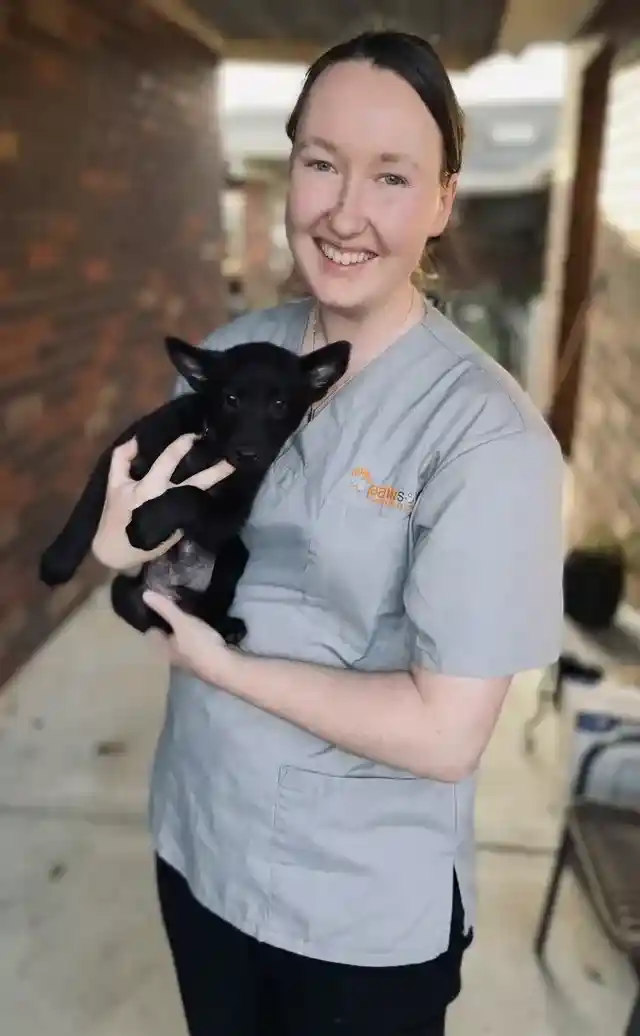
Dr Sarah Webb

Dr Sarah Webb is a Melbourne-based veterinarian and Charles Sturt University graduate with experience across mixed practice, locum work, and mobile veterinary care. She has a special interest in poultry and backyard chicken health, alongside her work supporting dogs, cats, and other animals. Dr Sarah brings a practical, compassionate approach to veterinary care and is also passionate about mental health and wellbeing within the veterinary profession.

Open 7 days a week from 6:00am to 11:00pm including public holidays

© 2026 Pawssum Pty Ltd. All rights reserved.