Diabetes in Dogs: Symptoms, Diagnosis and Treatment | Australian Vet Guide
Almost every diabetic dog I have diagnosed came in for something else.
If you’re reading this and thinking your diabetic dog requires insulin, you’re not alone. But you’re also not alone in the fact that you did not ring the vet up with that specific reason. You rang them up because your dog was drinking a lot of water or had lost weight or was having accidents indoors.
Nobody in their right mind would ring the veterinarian’s bell and say “I think my dog has diabetes.” But they would ring if anything out of the ordinary was going on with their dog.
So this is about the signs of diabetes in a real house
What diabetes is in a dog
Diabetes mellitus means that the body of the dog cannot move the glucose away from the bloodstream and into the cells where it is supposed to be used for energy. This can be caused by either the pancreas no longer producing enough insulin, or the body cells no longer responding to insulin properly.
In dogs, it is nearly always the first. Diabetic dogs have lost the cells that make insulin, thus they must take insulin injections for the rest of their lives. This is different from cats with diabetes mellitus, whose condition can go into remission, and different from type 2 diabetes in humans, who often manage the disease through diet and tablets. Dogs do not respond to oral medication for diabetes in the same way that humans do.
That sounds daunting, but what most owners have to do is give their dog two injections per day with their meals. It is not as difficult as it sounds at first glance.
The signs, and what they look like at home
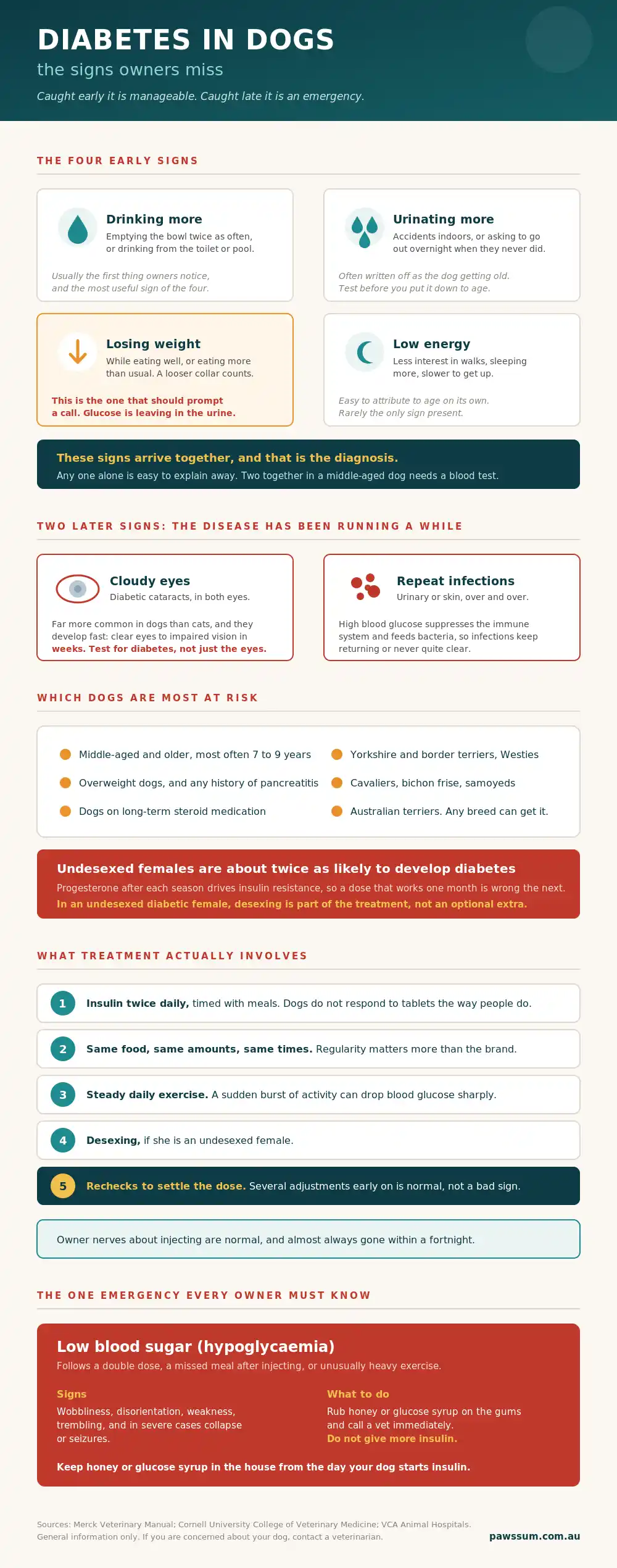
There are four signs of diabetes mellitus in dogs, and they will all present themselves together.
Drinking noticeably more water. This is the first sign most dog owners will notice. Their dog will drink more water than it used to, even in periods when it is hot out and they have to refill the dog’s water bowl more often. They may even begin to drink from the toilet or the swimming pool when they used to drink from only their water bowl.
Urinating more, or having accidents in the house. This is the second most common sign of diabetes in dogs. Most dogs will begin to wet the bed in their sleep or ask to go outside in the middle of the night when they used to sleep through the night without needing to go outside to urinate. Many owners may think this is due to the dog becoming old and having issues related to the normal aging of dogs. However, before putting the dog down due to these signs, owners should perform a blood test to rule out diabetes.
Losing weight while eating well, or eating more. A dog that is always hungry and eating well but losing weight is losing calories somewhere in the body. Glucose is spilling into the urine.
Low energy. A dog with diabetes may not have as much enthusiasm for walks, or may sleep more.
Two further signs of diabetes show up later in the illness.
Cloudy eyes. This is one of the most common signs of diabetes in dogs, compared to cats. A dog can develop cataracts quickly if they have diabetes. If a dog’s eyes become bluish or milky in both lenses, the dog should be tested for diabetes.
Repeated infections. Diabetic dogs often suffer from urinary tract infections or skin infections due to the suppressed immune system of the dog with diabetes.
Which dogs are more at risk?
Dogs of middle and elderly ages, between about seven and nine years.
Undesexed females. Again, this risk factor is one that most dog owners would not expect. Females are roughly twice as likely as males to develop diabetes. The reason for this is that the progesterone hormone that is naturally released from females after each of their seasons can lead to insulin resistance. If a female dog has been diagnosed with diabetes, desexing her is part of the treatment for her diabetes, as it is often very difficult to control a diabetic dog while she is cycling.
Certain breeds of dogs are more at risk of developing insulin resistance and diabetes than others. Yorkshire terriers, border terriers, Cavalier King Charles spaniels, bichon frise, West Highland white terriers, samoyeds and Australian terriers all fall into this category of breeds at risk of developing diabetes. However, any breed of dog can develop insulin resistance and diabetes.
Dogs that are overweight, or who have a history of pancreatitis.
Dogs that are on long-term steroid medication.
Case examples from home visits
The cases below are composites of actual dogs that our mobile vets have encountered on visiting Australian homes. While information has been changed to ensure the identities of the owners and dogs remain private, the conditions that existed in these cases are representative of many of the reasons that dogs are turned in to mobile vets’ care.
The bichon who had “just got lazy”
This small dog is a nine-year-old bichon frise from suburban Melbourne. When the owner booked the appointment for the dog, he had recently become somewhat lazed in his usual activities during the autumn season.
During the appointment, though, the owner revealed two issues regarding the dog’s health that she had not previously shared with the mobile veterinarian. One was that she had begun to refill the dog’s water bowl twice a day, rather than once. The second was that the dog had a new smaller collar - the old one had become too loose during the summer season.
That combination: drinking more and losing weight silently - is diabetes until proven otherwise. The blood and urine tests confirmed high blood glucose and glucose in the urine, which, together with the clinical picture, led to the diagnosis.
He was started on insulin twice a day with meals. His owner was extremely nervous about injecting him - the most common reaction to such a suggestion. Most of the first visit was spent teaching her how to do it and by the second week she had it down without thinking about it. He is still well.
The purpose of this case is to show how neither sign alone would have warranted a call to the office. Together they amounted to the diagnosis.
The undesexed kelpie cross who kept relapsing
A seven-year-old undesexed female kelpie cross in regional New South Wales, diagnosed with diabetes, but whose glucose levels were not stable on her insulin and diet.
The progesterone levels after each cycle were causing insulin resistance, so a dose that worked for her for one cycle would not work for the next cycle.
When she was desexed, her diabetes became manageable on a stable dose of insulin.
This is the most under-appreciated fact about canine diabetes. If you have an undesexed female with diabetes, desexing her is a treatment for the diabetes. Any veterinarian who looks after this dog should raise this issue with the owner as soon as possible.
The labrador who was already in trouble
An eleven-year-old labrador in outer Brisbane. The owner came in because of vomiting, weakness, and no interest in food. The dog had been drinking heavily for a few weeks.
His breathing was odd, he was lethargic and dehydrated. Diabetic ketoacidosis was the most likely cause of this dog’s problems. When the diabetes is left uncontrolled, the dog’s body begins to break down its fat stores for fuel. This creates acidic compounds in the blood.
This condition can’t be treated at the home visit. The dog needed to be taken to the hospital to receive intravenous fluids and be monitored.
I include this case for one reason. The weeks of drinking would have otherwise permitted testing, at which point a diagnosis could have been made and a treatment established that the owner could manage at home. By the time he was vomiting, however, he was admitted to the hospital for critical care, with little chance of survival.
How it is diagnosed
The diagnosis of diabetes mellitus in dogs is genuinely straightforward. Unfortunately, it is also the reason why the disease is so frustratingly often diagnosed late.
In order to diagnose a dog with diabetes mellitus, the veterinarian must find clinical signs of the disease, high blood glucose in the blood, and glucose in the urine. Samples of blood and urine can be collected at the home visit, and a disadvantage of the disease in dogs is that glucose levels are less likely to surge during a home visit than when the dog is at the clinic.
Your vet will usually also check for pancreatitis, urinary tract infection, Cushing's disease, and kidney and liver function. A test called fructosamine shows average glucose over the preceding weeks.
What treatment actually involves
Insulin injections, twice daily. The needle is very fine and most dogs do not feel it. They will happily stand patiently for the injection as a reward of food is offered. Most owners feel anxious about injecting their dog but this usually passes in a fortnight.
A consistent diet, fed at consistent times. The changes are not to the food, but to the consistency of the diet.
A steady daily exercise routine. Consistency is more important than a lot of exercise - a burst of strenuous activity at one time can drop blood glucose levels.
Desexing, if she is an undesexed female.
Monitoring blood glucose levels and dose adjustments. This is especially important in the first few months on insulin - there will be a couple checks and glucose curve measurements to find the correct insulin dose. This is a normal part of insulin therapy.
Ongoing costs. The costs of insulin, syringes, prescribed food and monitoring are ongoing costs. It is worth having a conversation with your veterinarian about these costs prior to initiating insulin therapy for your diabetic cat.
The one emergency to know about
Hypoglycaemia, meaning low blood glucose, is the main risk for dogs on insulin.
It can result from accidentally taking a double dose of insulin, skipping a meal after taking insulin or exercising excessively.
Symptoms include wobbliness, disorientation, weakness, trembling and in severe cases, collapse or seizures.
If your dog is on insulin and starts to show signs of hypoglycaemia rub honey or glucose syrup onto their gums and contact your vet. Do not give insulin to a dog that is becoming wobbly or vacant. Do not try to make a dog that is collapsing to the ground swallow anything.
Every owner of a diabetic dog should be told this when they are first diagnosed and be supplied with honey or glucose syrup to keep at home in case of an emergency.
When to book an appointment
Book your dog an appointment if he's drinking more than usual and you can't explain it to you by the weather or his activity. Book him if he's started having accidents in the house despite being house trained. Book him if he's losing weight even if he's eating normally or even more than normal. Book him if he develops cloudiness in both of his eyes or suffers from infections that seem to keep coming back.
Call the vet urgently if your dog has been diagnosed with diabetes and starts to vomit, refuse to eat, or becomes weak or breathes strangely.
None of these signs prove that your dog has diabetes. Polydipsia and polyuria can be caused by other medical conditions as well. All of them are important to diagnose early in their course, however.
The test is simple. The delay is what causes the harm.
Pawssum's mobile vets attend homes across Sydney,Canberra, Newcastle, the Central Coast, Adelaide, Perth, Brisbane, the Gold Coast and Melbourne. If you suspect tick paralysis, call us and we will attend urgently or direct you to the nearest facility equipped for emergency vet care.
By Pawssum
Last updated on 7th August 2026
About the author


Pawssum provides affordable and convenient pet care in the comfort of your home by local, trusted vets.
Our company
Open 7 days a week from 6:00am to 11:00pm including public holidays
© 2026 Pawssum Pty Ltd. All rights reserved.