Paralysis Ticks in Dogs and Cats in Australia: Signs, Treatment, Prevention
The paralysis tick, Ixodes holocyclus, kills more Australian pets each year than snake bites. Each year, thousands of pets are presented to vets with paralysis caused by the tick. The pets that we lose to this condition are almost always those that we find in time to treat them.
Here’s all about the paralysis tick, where they live, the signs of tick paralysis and what we do to treat the condition.
Where paralysis ticks live and when
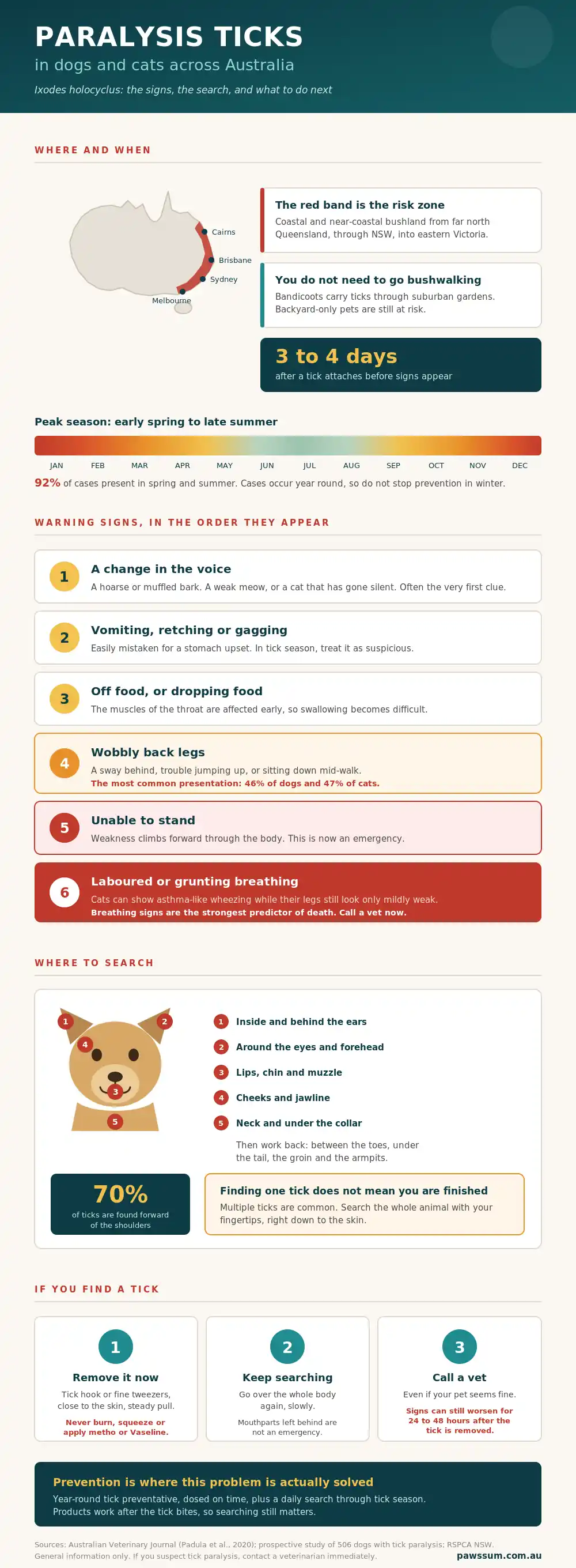
Ixodes holocyclus is located in the coastal and near-coastal bushland areas of Australia, from Queensland to Victoria. Sydney’s northern beaches and suburbs, the Central Coast, the Gold Coast and Brisbane are all at risk of tick infestations. The other Australian states do not have established populations of ticks, but the movement of pets into these regions exposes them to the tick.
Cases of paralysis caused by the tick occur year-round but are seen most in spring and summer. The warm, wet weather months bring the most cases of tick paralysis. From September to February is the busiest time of year for mobile vets who treat tick paralysis cases. A wet spring can lead to more cases throughout the year.
One common misconception is that a dog must go into the bush to encounter a tick. Ticks follow the bandicoots, who live in suburban backyards. Therefore, some dogs that present with tick paralysis have never left their backyard.
What the toxin does
The adult female tick attaches to a dog or cat and feeds upon the host. The saliva that the tick deposits into the host contains a neurotoxin that blocks the release of acetylcholine. This chemical is responsible for sending the signal from the nerve to the muscle to contract. Without the ability to release acetylcholine, the muscles of the pet become paralyzed.
The paralysis usually begins in the hind legs and progresses to the muscles in the chest and throat. The pet does not die from the paralysis alone. The pet is unable to breathe appropriately or to eat or drink because the muscles necessary to perform these actions are paralyzed.
The signs of tick paralysis usually appear three to four days after the tick first attached itself to the pet. At the first sign of tick paralysis you should act quickly. A tick that you find today may have been feeding for several days.
The signs of tick paralysis
The first sign of tick paralysis in some pets is a change in their bark or meow. The larynx - the vocal cords - are affected by the neurotoxin early in the progression of tick paralysis. The affected dog or cat will show a change in their bark or meow; it may be hoarse or weak.
Vomiting is another early sign. A pet may experience retching or gagging even when they have no appetite.
A loss of appetite is often seen in cats or dogs with tick paralysis.
The paralysis may begin with the hind legs becoming weak and unsteady. About 46% of dogs and 47% of cats show weakness in the hind legs as the first sign of tick paralysis.
As the tick paralysis develops the dog or cat may be unable to stand on their hind legs. The weakness spreads forward through the body.
The breathing of the cat or dog may become laboured or grunting. In some cats there is an asthma-like constriction of the airways even while they are weak in their limbs.
Breathing is affected in the majority of pets with tick paralysis. Respiratory signs are the strongest predictor of the survival of the pet.
Case examples from home visits
All of the following cases are representative of the conditions presented to mobile vets in Australia:
The kelpie cross with a "sore back"
A four-year-old kelpie cross lived in a bushland suburb of Sydney. The owner noticed that the dog had become unsteady on his back legs and thought that he had strained a leg jumping off the deck.
When we asked the owner to listen to the dog’s bark she heard that it sounded odd as if the dog had a sore throat. Upon examination the dog had weakness in his hind limbs and a reduced gag reflex. A search of the dog’s coat revealed an engorged female tick located tucked inside one of the dog’s ear pins. The tick was removed and the dog transported to a clinic for antiserum treatment. His preventative drug had been stopped over the winter holiday season.
The indoor-outdoor cat that stopped meowing
An eight-year-old domestic shorthair lived on the Central Coast. The owner called to report that the cat was noisy in his breathing. Upon further questioning, though, the owner revealed that the cat had stopped meowing at all for the past day.
Cats usually hide illness from their owners. Upon examination the cat had an audible wheeze when breathing and weak limbs. The asthma-like constriction of the airways can occur even in a cat while it is still strong in its limbs. Two ticks were discovered on the cat. Because there is a risk of reaction to the antiserum given to a cat the owner took the cat to a clinic able to offer purified canine IgG. The cat recovered. The success rate for giving antiserum to cats in Australia is around 95% but again relies on early detection of the condition.
The palliative dog whose owner could not travel
This 13-year-old labrador had developed arthritis in his joints. The owner could not easily travel with the dog in his car. When the dog began to vomit and was unable to stand the owner contacted a vet. A mobile vet was sent to the location where the dog was found with a tick behind one of his elbows. Given the age of the dog and the weakness that was shown by the dog it was clear that hospitalization was required for treatment. The mobile vet was able to arrange transport of the dog to the hospital.
Some people ask if mobile vets can treat tick paralysis at the owner’s home. We cannot. Any vet who tells you that they can treat tick paralysis at the home is doing you a disservice. We can attend to the location quickly, remove the tick and get the pet to the correct clinic.
What treatment involves
Tick antiserum is the only treatment that has been shown to be effective with tick paralysis. The antiserum has been used as the treatment of choice since the 1930s. It is given intravenously over time with close observation of the pet because an adverse reaction is possible.
In addition to antiserum the dogs and cats require sedation, oxygen therapy and nothing by mouth. In severe cases ventilation is required. Most patients spend between two to four days in the hospital.
The cost of treatment varies. For a mild case given early the cost will be a fraction of the cost for a dog or cat requiring ventilation.
How to remove a tick that has been found
Do not wait to take your pet to the vet before removing the tick. Each passing hour that the tick is attached means more toxin is being absorbed by your pet.
Use a tick removal hook or fine-tipped tweezers to remove the tick as close to the pet’s skin as possible. Pull the tick straight out without squeezing the body of the tick. Do not use methylated spirits or Vaseline to remove the tick as this may cause it to inject more saliva into the pet’s body. Do not attempt to burn the tick off the pet.
Should the mouthparts of the tick remain behind do not panic. The toxin that causes tick paralysis comes from the tick’s salivary glands and they will come out of the body of the pet when the tick dies.
Search for other ticks on the pet. More than one tick is common on a pet who has been bitten. Search the pet’s body with your fingertips. Focus on the head, ears, lips, chin, neck, between the toes and under the collar. Around 70% of ticks live in the forward portion of a pet’s body - in front of its shoulders.
Call your vet whether or not your pet has any signs of tick paralysis. Any sign of tick paralysis means that your pet needs to be assessed by a vet. Even if your pet has no signs at all the tick may be actively feeding and a visit to the vet will ensure that your pet is monitored for at least 24-48 hours.
Prevention, which is where this problem is actually solved
The isoxazolines have changed the game considerably. Four are registered with the Australian authorities for use on dogs: fluralaner (Bravecto), afoxolaner (NexGard), sarolaner (Simparica) and lotilaner (Credelio). Options exist for cats as well.
A few points I make to all clients who enquire:
Firstly, these products only work after the tick bites the animal. The tick must feed to take up the product and die. So while the protection is very good, it is not complete, and ticks can still be found on the animal.
Secondly, do not stop these products over winter in endemic areas of ticks. This is the cause of a large portion of spring cases.
Thirdly, the dosing intervals are not suggestions. A three-month chewable given at four months will leave a gap in protection. An annual injectable is available for dogs though.
Lastly, if you are travelling to the east coast of Australia with a pet from Perth, Adelaide or Tasmania, start the prevention prior to travel. Vets in tick endemic areas will see these cases every season. Those outside those areas may not.
When to make the call
Ring your vet immediately if you notice any change in the voice of your pet that was previously normal, if your pet is vomiting, wobbliness in the back legs, change in breathing - any of these symptoms warrant immediate attention. These symptoms can be easily missed in the middle of the night, and will not resolve on their own. If you find a tick on your pet, remove it and then call your vet for advice. The earlier the intervention the better. Late intervention can be an emergency too, but one I would like to have with fewer pet owners each spring.
Pawssum's mobile vets attend homes across Sydney,Canberra, Newcastle, the Central Coast, Adelaide, Perth, Brisbane, the Gold Coast and Melbourne. If you suspect tick paralysis, call us and we will attend urgently or direct you to the nearest facility equipped for emergency vet care.
By Pawssum
Last updated on 4th August 2026
About the author


Pawssum provides affordable and convenient pet care in the comfort of your home by local, trusted vets.
Our company
Open 7 days a week from 6:00am to 11:00pm including public holidays
© 2026 Pawssum Pty Ltd. All rights reserved.