How to Tell If Your Cat Is Sick: Vet Home Check | Pawssum
Cats are extraordinarily good at hiding illness. It's not that they are stubborn, it's that they are instinctively driven to hide weakness from their prey drive, a sick cat is a target for others, so it's better for them to appear normal.
The consequence of this is that when a cat does become unwell enough to warrant the owner's attention, they have likely been unwell for several weeks. This is something we see on many home visits from owners who state that their cat suddenly became unwell on a certain day, however on examination they are well aware that the cat had been showing signs of ill health for several days prior to the visit.
The signs of illness in cats will be more subtle than dogs, changes to routine being the main indicator of ill health.
The quiet signs that come first
These are changes that owners usually only notice in hindsight
Hiding. Cats that normally like to sleep in sunny spots may start to prefer the darkness under the bed or the couch or the wardrobe. This is one of the first signs to appear in a cat that has never previously been prone to hiding.
Grooming changes. Cats are normally very tidy with themselves and their grooming. If their grooming becomes sloppy, and their coat starts to become greasy, clumped or flaky, this can be a sign that the cat is unwell. The same is true of grooming in the reverse; if a cat over-grooms in one area of their coat until it becomes bald, this can be a sign of discomfort or irritation at that spot on their body.
Less jumping. Not getting on the bed any more. Taking the couch in two steps instead of one. Choosing the floor over the windowsill. These are all signs of ageing, usually due to arthritis, which is very common in older cats, but treatable.
A change in voice. If your cat is more vocal than usual, especially at night, or one who has become very quiet, note this.
Not using the litter tray properly. Perhaps they often use the tray, but also go beside it, or somewhere new in the house, or spend longer in the tray than usual.
Sitting differently. Cats who feel unwell typically exhibit a hunched up posture with their paws tucked up under their bodies and their head to one side. This is a pose that all cats will adopt from time to time. If, however, their usual pose is this position then they might be feeling unwell.
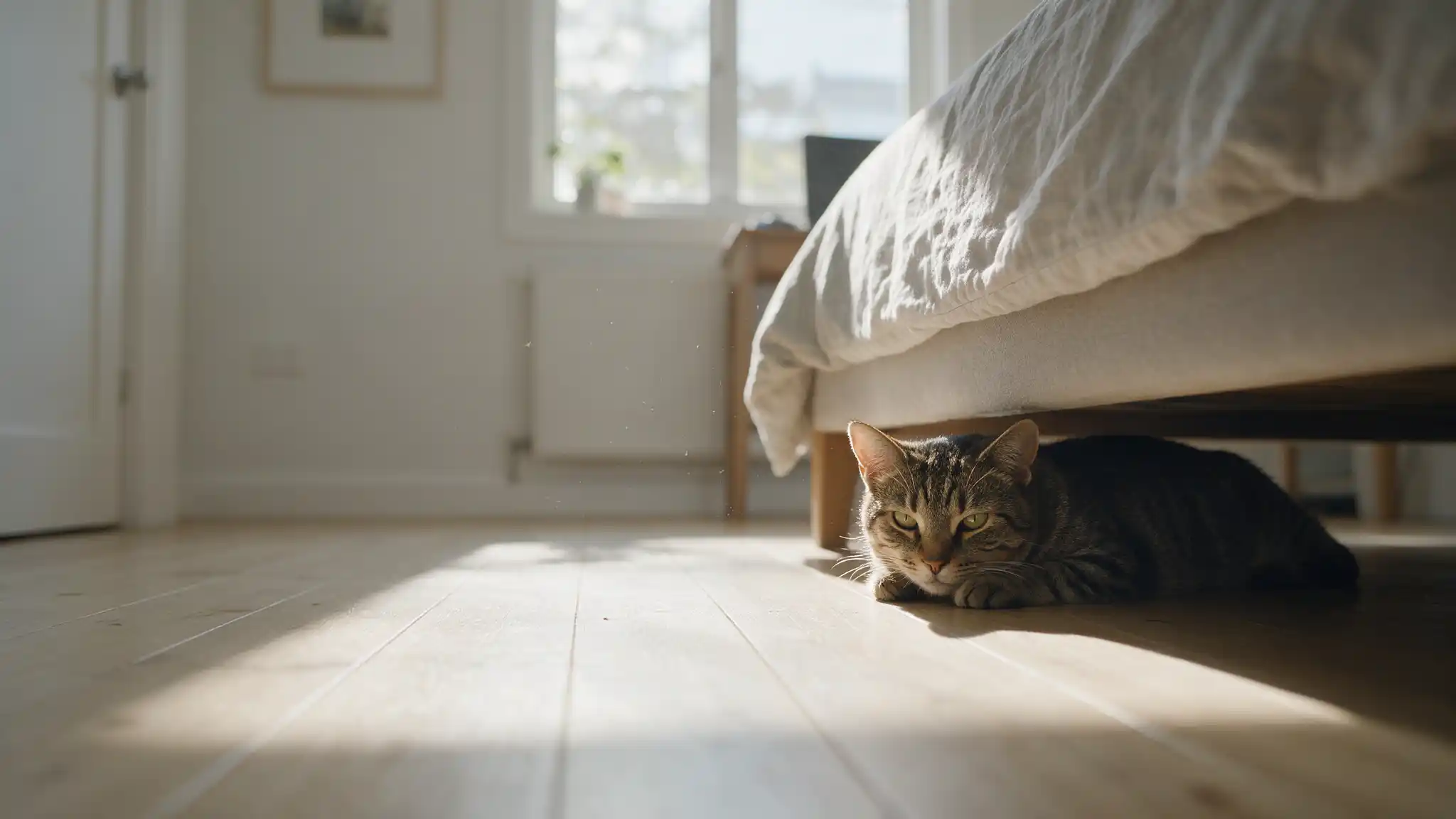
Withdrawal from the household
- Not coming out for dinner
- Not greeting you when you arrive
- Not sitting where they always sit
The home check, and the numbers behind it
Do this when your cat is relaxed, ideally when they are asleep. If your cat will not sit well with any of this, do not press on. The stress to your cat will provide you with false readings about their health, so do not make their life difficult.
Count the breathing while she sleeps
The most useful measurement an owner can take of their cat's breathing, and one of the easiest.
To count the breaths of your sleeping cat, simply watch their chest. One rise and fall of the chest is one breath. Count the number of breaths that pass in thirty seconds, and double that number.
Under 30 breaths per minute is the norm for cats who do not have any heart or lung related diseases. Most healthy cats have a breathing rate of around the teens or low twenties when sleeping. Any reading over 30 breaths per minute while resting is considered abnormal, according to Veterinary Cardiac Services Australia, and warrants being called for further information from your veterinarian. Breathing with heaving of the belly indicates that the breathing is laboured.
This is more important for cats than almost any other species. Because cats hide heart disease so well, one of the first things that indicates fluid around the lungs is an elevated sleeping respiratory rate. If your cat has a heart murmur, ask your veterinarian to monitor your cat's sleeping respiratory rate each week.
Cats should not pant. If your cat is panting or breathing with an open mouth, except after playing very hard or traveling in the car, it is an emergency. It is not like dogs panting.
Look at the gums
Lift the lip of your cat to examine the gums. The gums should be pink and moist. Press your fingertip against the gums for a second and release. The gums should return to their normal colour in one to two seconds (Perth Vet Emergency and the Merck Veterinary Manual).
|
Gum colour |
What it can point to |
Urgency |
|---|---|---|
|
Pink, refills in 1 to 2 seconds |
Normal |
Reassuring |
|
Pale or white |
Anaemia, blood loss or shock |
Emergency, now |
|
Blue, grey or muddy |
Not enough oxygen |
Emergency, now |
|
Yellow |
Liver disease or red cells breaking down |
Same day, and common in cats who stop eating |
|
Very red |
Fever, heat stress or early shock |
Same day |
|
Brown, with a swollen face |
Paracetamol or another poison damaging red cells |
Emergency, ring 1300 869 738 |
|
Refill slower than 2 seconds |
Poor circulation |
Same day |
Yellow gums deserve particular attention in cats. If a cat stops eating for a few days, it can develop a liver problem as a result. Thus, loss of appetite in cats is treated more urgently than in dogs.
Feel the heartbeat
Place your hand flat against the cat's left side, behind the left elbow. Count for fifteen seconds, and multiply that by four.
A normal resting heart rate for cats ranges between 140 and 220 beats per minute. Most cats typically fall within the range of 140-180 beats per minute when they are relaxed (Perth Vet Emergency). This normal rate for cats is fast by human standards. Cats tend to reach the higher portion of their normal resting rate when they are stressed. Slow rates indicate possible illness.
Check the hydration
Feel the gums. They should be slippery. Tacky or dry gums indicate dehydration. Lift the skin over the shoulders and let go; however, in thin or old cats the skin returns to normal without tention so this test is unreliable.
Dehydration is something many cat owners do not realise is such a major issue for their cats. Due to cats' weak thirst drive and the common occurrence of chronic kidney disease in older cats, dehydration is a significant problem.
Temperature
A normal temperature for cats is between 37.8 and 39.2°C (Perth Vet Emergency). The only true way to determine a cat's temperature is with a digital thermometer inserted into the rectum. Many cats will not allow this, which is fine as forcing the cat to tolerate the thermometer can damage the relationship between the owner and cat. Furthermore, a temperature below normal is just as serious as a high temperature in a collapsed or unwell cat.
The four cat emergencies to know
A cat straining in the litter tray
This is the one to memorise. If your cat is going in and out of the litter tray, straining and crying but producing little or no cat litter, they could be blocked. Although male cats have narrow urethras that are more likely to get blocked, female cats can also get blocked urethras so do not stand on the idea of the sex of the cat as a reason for this sign alone (Greencross Vets). It is an agonising and potentially fatal issue that can last around 24 to 48 hours if not treated.
Many people will think that their cat is having constipation (Animal Emergency Service). If your cat is straining but there are no wet clumps of cat litter in the litter tray, this is an emergency and you must act now.
Signs to act on: going to the tray, straining with nothing produced, crying in or near the tray, licking at the back end, blood in the urine, vomiting, hiding.
There are two traps. If your cat goes outside you may never see any of the tray behaviour, but will only notice that the cat is crouched, vocal and hiding. A cat who was straining to produce urine but who has stopped doing so and lying flat and quiet is worse rather than better.
Not eating
A cat who has eaten nothing for 24 hours should be seen by a veterinarian. This is 24 hours because a cat who has not eaten for several days may develop hepatic lipidosis, a liver problem caused by fasting. Overweight cats are at the highest risk of developing this problem. The idea of straying 24 hours from normal eating is to find the cause and fix it before it becomes a second problem. This is one of the differences between a cat and dog world. This is one of the things that owners do not value enough.
Open-mouth breathing or panting
Covered above. A cat who breathes open mouth when resting is in emergency.
Sudden back leg weakness
A cat who suddenly cannot stand on one or both back legs and who has cold back paws may have a blood clot in the main vein of the hind leg, a saddle thrombus. This is excruciatingly painful for the cat and requires immediate attention from a veterinarian. A saddle thrombus is usually the first sign of an underlying heart problem that the cat owner was unaware of all along.
When to call, and how urgently
Emergency: go now
If your cat exhibits any of the following symptoms, contact your veterinarian immediately:
- Straining to urinate
- Open-mouth breathing or panting when at rest
- Pale, white, blue or grey gums
- Collapse
- Loss of consciousness
- Weakness or dragging of one or both back legs
- A seizure
- Pressing head against a wall or furniture
- Suspected paralysis tick (changed meow or wobbliness)
- Suspected snake bite
- Any trauma
- Known or suspected poisoning (true lilies can cause kidney failure in cats)
Two numbers to have:
For poisoning call the Animal Poisons Helpline on 1300 869 738. They are staffed by veterinary toxicologists and are open 24 hours a day. For everything else on this list, head to your nearest 24 hour emergency animal hospital. These are trips to the hospital as they will require anaesthesia, oxygen and surgery.
Same day
- No food for 24 hours
- Vomiting (particularly if the animal is also lethargic)
- Yellow gums (or yellow eyes/ears)
- Increased thirst and urination
- Hiding behaviour (especially if the animal is normally social)
- Respiratory rate of over 30 breaths per minute when measured while the animal is sleeping
- Blood in urine or faeces
Book in the next few days to discuss any of the following concerns for your cat:
Australian specifics for cat owners
Paralysis ticks
Paralysis ticks are caused by the bites of the paralysis tick beetle, Ixodes holocyclus. These bugs live along the eastern seaboard of Australia, from north Queensland to Victoria. The further south they are located, the shorter the time period during which they are active outside, they live year around in the north, but mild winters in Australia bring the tick season forward (RSPCA Australia). These ticks mostly live on indoor cats that have access to the outdoors.
The early signs of tick paralysis are a change or loss in the meow of the cat, wobbliness in the back legs of the cat, and even gagging, retching, or regurgitation in some instances. Always search the head, the chin, the neck, and the area between the shoulder blades of the cat for ticks. These ticks tend to live in areas of the body that a cat cannot groom effectively. Thus, it is possible for a cat to groom a tick off of its body such that there is only a small crater in the cat's coat, yet the tick could still be causing tick paralysis (Lort Smith).
Two things owners get wrong. Firstly, that once the tick has been removed from the cat, the effects of the tick's toxin have not finished working, the tick can continue to affect the cat for several hours after the tick is dead and the cat needs to be seen. Secondly, owners should take away the food and water that the cat consumes before they travel with the cat to remove the risk of the cat being unable to protect its airway. See our paralysis tick guide.
Permethrin and dog tick products
Dog tick and flea products should never be put on cats. Cats should also not be near dogs that have just received a tick treatment for their dogs. The majority of spot-on treatments for dogs contain permethrin, which is toxic for cats. The Animal Emergency Service sees numerous cats treated for permethrin toxicity each year. The symptoms can start within an hour of exposure to permethrin, including tremors, twitching, seizures and a high body temperature. There is no antidote for permethrin toxicity (Animal Emergency Service). If the cat has been treated with permethrin, owners should wash the cat using lukewarm water and dish detergent. After washing the cat, owners should immediately take the cat to the nearest emergency vet clinic, who can treat the intoxicated cat. Vets can be contacted through the following number: 1300 869 738.
Lilies
Lilies. True lilies, including species such as Easter lilies, Asiatic lilies, tiger and stargazer lilies and daylilies will cause acute kidney injury in cats. All parts of the plant are dangerous, including the pollen and the water in the vase, any cat that passes by a true lily and cleans the pollen out of their coat will be at risk. Early treatment has often been successful in treating kidney injury caused by these plants (Animal Poisons Helpline).
Peace lilies and calla lilies are not true lilies and will not cause kidney damage. However, both plants contain insoluble oxalate crystals that will result in the cat developing a burning sensation in their mouth, drooling and pawing at their face, symptoms that will settle once the cat has ingested the plant. However, there are two other plants that contain the word "lily" in their name that can be just as dangerous to cats. Lily of the valley will affect a cat's heart due to its cardiac glycosides content; even a small amount can be harmful to the cat. Flame lily or glory lily (Gloriosa superba) is a naturalised species along the coast of Queensland and New South Wales Australia and will cause organ failure in cats that ingest the plant. If your cat has chewed on anything that contains the word "lily" in its name, call the Animal Poisons Helpline on 1300 869 738 for further information on the type of lily your cat may have encountered.
Human painkillers
Never give a cat human painkillers. Paracetamol (Tylenol) is toxic to cats and just one tablet can kill them. The first signs of paracetamol poisoning are a brown gums and tongue and a swollen face (Animal Poisons Helpline). The same is true for painkillers such as ibuprofen and aspirin.
Heatstroke
Heatstroke is less common in cats than in dogs. But it does happen. The early signs of heatstroke in cats are cat-specific and can easily be missed. Look for frantic grooming, cats will groom themselves to feel cooler, or they may want to be on the tiles in the house or in the bath. They may also appear restless. Then the signs of heatstroke appear: panting, drooling, lethargy or wobbliness.
Immediately cool the cat down and ring the vet. Wet the cat down with cool (not ice cold) water and place a fan on the cat. Do not use ice, ice baths or ice packs on the cat. Stopping cooling the cat once it is comfortable is also vital as the cat will begin to shiver and make more heat (Animal Emergency Service, Lort Smith).
Snake bites
Snake bites. Cats tend to be very curious hunters and will often be bitten more than people may expect. Signs of a venomous bite include weakness, wobbliness in the back legs, dilated pupils, vomiting and collapse.
If a cat collapses or vomits but then seems to later recover, it is important to remember that this is not the end of the envenomation process. The symptoms can take up to 25 hours to emerge following a suspected snake bite (Lort Smith). Despite the cat's condition, it is still important to take the cat to the veterinarian. While en route to the clinic, attempt to keep the cat as still and quiet as possible. Do not wash the cat following the bite as the veterinarian will need to analyze the venom to determine the type of snake bite (RSPCA Australia). Using a tourniquet or attempting to kill the snake will not help the cat and should not be attempted.
Cane toads
Cane toads live in Queensland, the Northern Territory, northern New South Wales and the Kimberley. While less common in cats than in dogs, it can happen. Signs of toxicity include drooling, foaming at the mouth, pawing at the face, bright red gums, dilated pupils, tremors or being in a trance-like state after mouthing something outside the mouth. Wipe the cat's mouth and gums with a damp cloth, wiping from the inside of the mouth outward so the cat does not swallow the water (Animal Emergency Service).
Can my cat feel pain?
Yes, cats can feel pain and there is a tool to assess this at home. The Feline Grimace Scale rates five features of a cat's face for pain: the position of the ears, the tightening of the eyes, the tension in the muzzle, the position of the whiskers and the position of the head. Each of these features is scored on a 0 to 2 scale. If the total score is 4 or more out of 10, the cat is experiencing pain that should be treated. This instrument was developed and validated by researchers at the Université de Montréal and was published in the journal Scientific Reports in 2019.
It is in active use in Australia, including at Veterinary Specialist Services in Queensland, and RSPCA Australia includes the same facial signs in its guidance on recognising pain in cats.
The tool is genuinely useful in that it can be used on photographs of the cat and in real time. However, it was developed and validated for assessing acute pain, so low scores do not rule out pain from conditions like arthritis or dental disease. For those conditions, behavioural indicators are more helpful.
Why cats do better with a vet who comes to them
The behavioural changes described here are all changes in normal behaviour. A cat's behaviour in a clinic visit and a consultation room is likely to be very different from their normal behaviour at home. A cat who does not like to jump onto beds will not jump onto the vet's examining table. A cat who likes to hide will hide in the travel carrier and appear frightened to the vet when travelling to visit them.
There is also the trip itself. For many cats, the carrier and the car are the most stressful thing that happens to them all year. A stressed cat will have a raised heart rate, breathing rate and blood pressure before the examination even starts. Some of the numbers a vet most wants to know about a cat are some of the hardest to obtain in a clinic.
At home the cat will stay in their own territory, preferably on their own chair. Our veterinarians have the same equipment as a clinic to perform blood tests at home.
If something is wrong with your cat, you can book a veterinarian to visit you at home or find out more about how much a mobile veterinarian costs.
Frequently asked questions
How do I know if my cat has become sick or is just sleeping a lot?
Cats sleep a great deal as healthy adults. Where the cat sleeps is more informative than the length of sleep.
A cat sleeping sixteen hours in their favourite spot is normal. A cat sleeping sixteen hours under the bed when they usually sleep on the couch is not.
What are the first signs that a cat is unwell?
The hiding of the cat, the reduction of grooming, the sleeping of the cat instead of jumping and playing, and a change in appetite are the first signs. In all likelihood, these are removals of normal behaviour rather than additions to the cat's behaviour. When a cat seems unwell, the owner usually notices that the cat is less present in the house than before.
My cat is not eating but otherwise seems fine. Should I wait?
No. 24 hours without eating is the threshold for taking a cat to the vet, regardless of how well they otherwise seem. This is because cats left to go without eating for several days can develop hepatic lipidosis, a liver condition caused by fasting, particularly if they are overweight. Getting them to the vet at 24 hours is about catching the cause of the loss of appetite before it develops into a second problem.
To determine if a cat is in pain, since they will rarely cry out in pain, observe their face using the Feline Grimace Scale and their behavior for any indications of discomfort. Less jumping, a hunched posture, not wanting to be touched in one place, over-grooming one spot, odd behavior around the litter tray, or hiding could all be indications of pain. Purring is not an indication of comfort when a cat is nearby, cats will purr when they are distressed.
Is my cat's nose supposed to be wet?
It makes no difference. Whether it is dry and warm or wet and cool, it is not a sign of illness in either state. Check the gums instead.
What does it mean if my cat is hiding?
If a cat who normally does not hide from people is exhibiting this behavior, it is a sign that something is wrong with the animal. It could be pain, nausea, or even a fever. Even if the rest of the cat seems normal, it is worth investigating.
How often should a healthy cat see a vet?
A healthy adult cat should see the vet at least once per year. However, according to Australian guidelines, cats should have a checkup every two months once they reach the age of one year. Greencross Vets recommends that all cats be examined every two months from the age of seven years, as they begin to show the signs of aging. The Cat Protection Society of NSW recommends six monthly visits for cats between the ages of eight and twelve years, though the American guidelines would place that age at thirteen to eighteen years. Around the age of seven, however, is a good time to schedule the vet visits for a cat. A cat's tendency to hide from illness means that most illnesses in an older cat are found during an examination checkup that the owner performed for the cat.
This article is general information and is not a diagnosis. If you are worried about your cat, speak to a vet.
Check out the why is my cat vomiting article
A lot of those cases can be found during the Pawssum annual check up
By Dr Olivia Kappel - BVSc/DVM, registered veterinarian
Last updated on 13th September 2026
About the author

Dr Olivia Kappel is a Veterinarian with Pawssum Mobile Vets, providing trusted veterinary advice and support to pet owners from the comfort of home. Based in NSW, and educated at the University of Sydney, Dr Olivia brings practical small-animal experience and a calm, compassionate approach to helping families understand their pet’s health concerns and next steps. Her work with Pawssum supports accessible, stress-free veterinary care for dogs and cats across Australia.
Our company
Open 7 days a week from 6:00am to 11:00pm including public holidays
© 2026 Pawssum Pty Ltd. All rights reserved.